There's no better way to see the world than on a bike. Join me on my rides around Europe to discover what lies beyond my handlebars

Sunday, 31 January 2016

Wailing about the walls

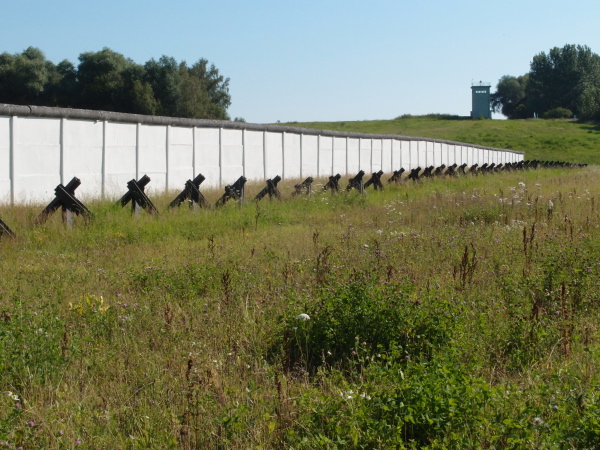
The original wall and watchtower between East and West Germany

Most people know about the Berlin Wall. But how many know much about the 1400km wall that divided families in East and West Germany for a more than a generation?

1400 Kilometers long.  A wall right across Europe. Part of the Iron Curtain. Dividing villages down the main street. Fences, Watchtowers. Mines. Dogs. Regular armed patrols. More than 1000 people killed trying to cross from east to west. Until 1989.


Riding along the old patrol routes
Now it is known as the Green Band, an area along much of the wall’s length that is a haven for plant and animal life. There was so little industrial or agricultural activity either side of the wall for 50 years that nature flourished while human activity and relationships shrivelled.

To cycle along the route of the wall takes you from the Baltic Coast through sandy flats, over hills and mountains, through forests, between meadows and into sleeping villages until it reaches the Czech border with Bavaria. This was once a “dreiländereck” where three countries met in one spot, a quiet patch of otherwise insignificant woodland.

Sections of wall remain where they isolated villages and divided communities
Riding the length also takes you deep into a tragic period of recent European history. Illustrating how ideology tore families apart, forced people to abandon their homes and livelihoods, bankrupted businesses and created an atmosphere of fear and mistrust.

Cycling the Deutsch-Deutscher Radweg (the German wall route) on its own or as part of the Iron Curtain Trail, is a great but sobering experience. It is not a bike path as such but a route on quiet roads and farm tracks and often along the bumpy old eastern patrol trials. You will come across watchtowers, sections of wall, see untold numbers of memorials and signs commemorating the re-opening of roads, follow the River Elbe and arrive in towns still struggling to return to prosperity. There are many museums well worth a visit.
 
Point Alpha where troops glared at each other across the wall
Along the way, close to village of Geisa is point Alpha. Here the American and East German troops glared at each other across the fence from watchtowers just 150m apart. In the adjacent museum is a display about the wall, comparing it with other walls separating peoples:
  • ·       dividing Israel from Palestine in the West Bank
  • ·       the wall which is meant to keep Mexicans out of the USA
  • ·       between North and South Korea

Less than two years ago, these were the only walls of any significance between nations and the exhibit indicated that these were as bad as the German wall had been.
 
As it used to be: the wall which divided this village right down the main street

In Nurnberg the Perimeter Protection Exhibition in January 2016, featured about 100 companies selling all kinds of perimeter protection gadgets, barriers, gates and equipment designed to keep people out, or in, was busier than ever. The market is booming as fences are being built across Europe and further afield – a 1000km fence between Turkmenistan, Afghanistan and Iran was recently completed.


After years of cycling around Europe, crossing borders which may appear on a map, but in fact are invisible and unmarked, pedalling unhindered between countries, how sad it is to see walls and fences being built between the Schengen countries as a result of the migrant crisis.

Deutsch Deutscher Bike Trail
The Bikeline series of guides is invaluable in helping find the route which is not well signposted in many places and often difficult to find. Accommodation in parts is scarce because tourism has not yet returned to this area.
www.esterbauer.com

Schengen
Schengen is a tiny town at the border of Luxembourg, Germany and France on the River Mosel. It was here, on a riverboat (there was no building big enough) that the plan was forged to enable free travel between EU countries. It would be a supreme irony if border controls were to be introduced here.

The Mosel is a river with an excellent bike path, great wines all along the route, and the opportunity to cross borders at will, no questions asked.
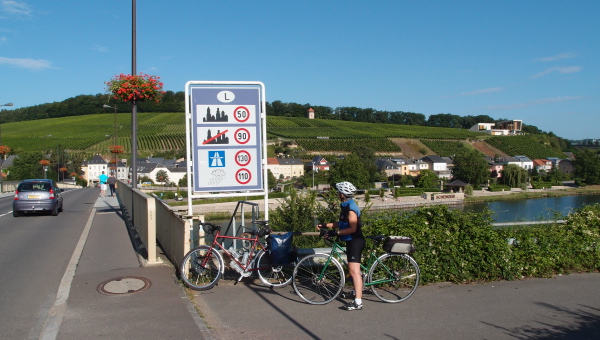
Schengen on the River Mosel, where Luxembourg, Germany and France meet

Wednesday, 13 January 2016

Hero, the novel bike with green roots

Greensboro's Main Street - boarded up shops - but the barber is still in business

With snow, slush, salt and grit on the roads, this is not the time of year for bike riding. Instead, here is a heart-warming story with an unusual bike at its centre.


Deep in Alabama's rural Black belt, in Hale County, is a little town called Greensboro, once an important cotton growing area with a high proportion of slaves to the white population. Later it was a bastion of the segregationists (and quite possibly those sentiments are still alive among some residents). Today, a large number of the descendants of the slaves live in poverty, often in shacks with no running water or sanitation.

Over the years, with the growth of out-of-town shopping malls, new highways shifting passing traffic away from the town, the centre of Greensboro has fallen into decay. Shops are closed and boarded, the antebellum homes around the centre are faded and peeling, and hardly a soul is to be seen on Main Street.

Pictured left is Lance Rake with his prototype hexagonal frame of bamboo strips


Into this sad situation comes a non-profit, self-help group aiming to revitalise the community and to assist the poorest members of the community into simple but modern and sanitary homes. With volunteers, schemes which help with finance in exchange for work, and a basic house design, HERO is transforming the lives of folks whose homes are without the facilities which we take for granted - and which one might expect everyone in the USA enjoys.

In addition, HERO, which stands for "Hale Empowerment and Revitalisation Organisation”, under its executive director Pam Dorr, has launched a number of ventures including the Pie Lab, a cafe in the town centre offering "food and conversation".

So where's the bike angle? Growing a short way from the centre of town is plenty of bamboo planted in the late 1800s. In 2009, as part of the Hero project, a team designed and began construction of cycles using bamboo as the frame. Now, under the guidance of Lance Rake, a professor of industrial design, in one of the empty shops in the main street Herobike builds and sells a range of street and touring bikes. The bamboo "tubes" are bound together with carbon fibre and, says Lance, offer a comfortable ride similar to that of steel frames.

Shop window model 

He has since begun working on a frame made of strips of bamboo bound together with glass fibre in a hexagonal cross section. Lance is also experimenting with weaving the bamboo strips to make a skateboard and an electrobike. All these products are using simple technology and locally available materials.

Made by the Kansas University students - the bamboo running bike

In January 2016 a group of design students from Kansas were doing a practical exercise at the Hero hq, building "running bikes" for children and using the bamboo strip technique for a wave board.

Most of the Hero bikes are bought on line and are also available in kit form. Workshops are run where you can, with guidance, build your own bamboo bike. Not only are the results practical functioning bikes, they are also a novelty which is contributing to the community effort in this struggling little town.

Find your Hero Bike here: http://www.herobike.org
More about the Hero project: http://www.herohousing.org

Kansas University students at work in the Herobike workshop
Bonding the joints

Bamboo drying in the January sun outside the Herobike workshop in the Greensboro main street


Thursday, 17 December 2015

Flat ride in flat white heaven


The coffee theme runs strongly through our rides, and the blog. So here’s a real treat, a short, flat circuit great views and some of the best flat whites you’ll drink anywhere.

The only possible snag is you have to start at the Te Papa museum in Wellington, New Zealand, and ride south around the harbour. The chances are you will either be battling your way into a gale or speeding along with the pedals idling. They don’t call it Windy Wellington without good reason.

Heading south around the harbor - its always windy


Keep south till you come to Lyall Bay where the wind will certainly be making its presence felt, turn right and a short way along, park up by the Maranui, one of Welly’s classic indie coffee houses where the food is great and the coffee strong.
 
At the Maranui - great coffee here


Caffienated up? Well, keep riding along the coast and keep going until you see the Bach. It’s only about 10k, raised up above the road, with a terrace overlooking the sea. It’s a bit rough and ready, but that’s the mark of the great Wellington café tradition. Here the full kiwi breakfast will set you up – along with another flat white.
 
"The works" at the Bach 

Did you have a horror of a headwind? Smile because you now head back to Lyall Bay but after passing the Maranui, keep straight on towards the airport. If you are in need of a quick caffeine lift, you will pass the Spruce Goose before running parallel with the planes taking off and then ducking beneath the runway.


There’s a little hill as you leave the airport but that’s about as tough as it gets. The coast road around Worriser Bay is a delight but look out for the sign that says watch out for penguins…but seriously, watch out for the penguins.

Watch out for the penguins crossing!


As you come back towards the city, there’s another top stop at the Chocolate Fish. It’s easy to spot because there’s a host of old bikes for children to belt about on while the oldies are downing another great coffee. There are some pretty gory looking cakes here too.


Pass the other end of the runway and keep following the bay beside the collection of wind driven sculptures. At the giant needle, turn right and before you know it you will have clocked about 45km and at least three flat whites.

If you aren’t on a high, you’d better order an extra shot in each coffee next time around.

Back in the city centre, the DeLuxe is another stop for a caffeine infusion


Great coffee, great volume too when its served in bowls like this


Friday, 13 November 2015

Cuba cycling - hurry, it's not too late


A bike ride in Cuba? What would that be like? Well, how about having  the chance to ride safely along a motorway. The opportunity to pick up hitchhikers (seriously!).  To ride with hummingbirds at your elbow and chat with a cigar-smoking cowboy on a horse as you progress side by side.

All that was a few years ago. December 1999, the very end of the last century. I can’t vouch for the same experiences today – though I doubt things have changed very much. But it will soon, now the atmosphere between Cuba and the US is thawing.

I flew with my bike into Havana with Cubana Airlines for some local colour en route and stayed a few days in Havana, my Roberts Clubman safely parked and locked to my bed. Then off along the Malecon, the beautiful road curving round the bay, lined with tall white buildings, once casinos and classy hotels. Before long, things go wrong and I am on the ramp down to the motorway. There’s a soldier at the bottom, bound to stop me. But no, he’d like a lift on the rear carrier – so would the other people waiting there.
 
People waiting for a lift - even the back of my bike will do

Off down the motorway, not a car to be seen. The local bike club joins me and we chat as we cruise along. They show me my exit – unsignposted but it is the right one. The lack of signposting everywhere means regular map reading, and the frequent need to ask the way. I am heading west, towards Viñales. The road is pretty good, the views great. People wave, whistle and call out as I pass.

Diary entry from Bahia Honda: Now I am sitting in a rocking chair in front of my Casa Particular (b&b). The bike is in the back yard with the cooking pot. In the street in front of me the neighbours are noisily playing dominoes. There are pigs, chickens and dogs all around. The sounds from neighbouring houses drift into the evening air – there can’t be many secrets here. The family chat away and I keep smiling and nodding though I haven’t much of a clue what they are saying. I guess this is the real Cuba.
 
Señor and Señora, my first Casa Particular hosts
The smooth road from Bahia Honda to La Mulata was one of the loveliest I had seen at the time and still is. In the distance, hazy blue mountains as the road wanders between palms and trees whose huge limbs form a canopy over the road. Among them are small homes and farms growing tobacco, coffee, sugar, melons, grapefruit, bananas and rice with oxen dragging ploughs through watery meadows.

I pass a coffee plantation and only when I stop, hear the laughter and chatting of the pickers at work. At a house round the corner beans are being roasted, the smell…ahh, the smell!
 
En route from Bahia Honda 

One of the loveliest roads I have cycled along

At every junction there’s a crowd waiting for a lift and every time I stop to ask the way, I have to turn down the opportunity of picking up a passenger. Not all roads are smooth, I cover extra kilometres dodging round potholes but as the traffic is scarce and generally noisy, it’s not a problem to be on the wrong side.

Heading back towards Havana, a guy on a chinese Flying Pigeon bike (like the Model T Ford, they are all black) ducks like a racer into the tuck position and sits on my wheel for miles as we head into wind. Now we’re passing a guy with a chicken hanging by its feet from his handlebars quietly clucking away.
 
Strange rock art along the road near Viñales

Rocky landscape and homes near Viñales

Tropical nights with downpours, exotic trees and plants, noisy birds and hungry mosquitoes, “son” music drifting in the warm, humid air, the sound of chattering voices in the distance. Hotel staff fast asleep in easy chair in the reception area – ah! Cuba!

Riding into Havana, I am hot, gritty, sticky, stinky. A motorcycle cop on a Moto Guzzi stops me. Speeding? No, he’d like my sweaty mitts. In Havana I swopped some water bottles with the bike taxi guy in exchange for a chance to drive his bike with him as passenger.

Cuba, a place to go cycling? Well it was great when I went. Havana is amazing. The countryside stunning. The people totally friendly and always after “souvenirs”. The food (then) pretty awful – lots of rice. Would I go again? Yes, certainly. However, on the way home I wrote: “the next bike ride should be in the first world, not the second or third. Austria has to be the number one cycling country”
 
Taxi guy with my water bottle - I gave him a ride in his taxi
Log
505km

Route
Havana, Quiebra Hacia, Bahia Honda, La Mulata, La Palma, Viñales, Pons, Cabezas, Piñar del Rio, Candelaria, Soroa, Las Terrazas, Meriél, Havana

Coffee
Everywhere, bold, black caffeine in tiny cups

You said it!
Condemn me. It is of no importance. History will absolve me – Fidel Castro’s self defence speech before the court in Santiago de Cuba, October 1953
Friendly people everywhere